When people talk of having been on a journey, they tend to be using the language of hackneyed metaphor. Not Paul Elliott. He has actually done the miles. And some of them have been hard.
He has travelled from the n-word-littered fields of his South London youth and, while building his reputation as a defender with Charlton Athletic, endured the monkey chants of provincial crowds. He has been to Italy and there, while still in his early twenties, discovered that racist abuse was complicated by a North-South divide. And then moved to Scotland, where the added ingredient of the foul brew was sectarian.
It was far from all bad, however, for Elliott says of his time in Pisa that he ‘’went a boy and came back a man’’, having enjoyed the way of life and learned so much about football from jousting with Ruud Gullit and Diego Maradona in what was then the best league in the world; and the love and respect he developed for Scots was reciprocated when the journalists, fans and fellow players alike voted him footballer of the year.
What’s more, Elliott returned to London to join Chelsea and, upon Andy Townsend’s departure, was made the first black captain of a club whose racist fringe had, not so many years earlier, been notorious. Times were changing for the better.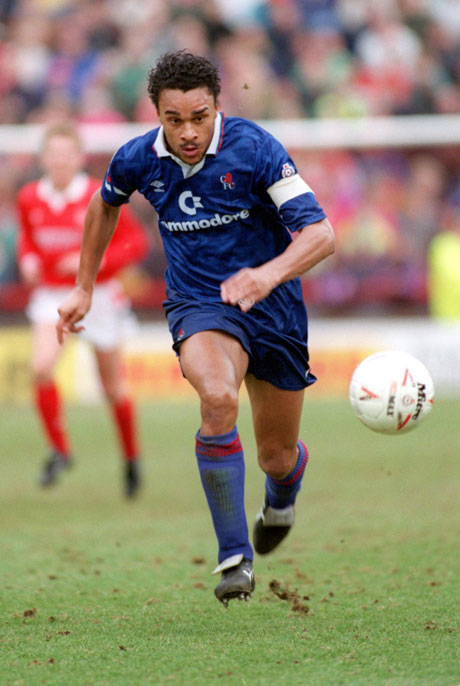
Except, suddenly, in the case of Elliott himself. He went into a challenge with Dean Saunders, then of Liverpool, and his right knee never recovered. At 28, he had played his last match. Even his subsequent law suit against Saunders was to be unsuccessful.
Quietly, though, the journey continued. Chelsea chairman Ken Bates never wavered in his support for Elliott, who coached the reserves and youths during the management of Glenn Hoddle and eventually, after also becoming involved in anti-racism initiatives, was appointed an MBE in 2003.
For services to equality and diversity in football, he went on to become a CBE in 2012 - only to have the prospect of a new career in football’s public life threatened by an n-word episode of his own furious making, which caused him to resign from his duties with the FA, UEFA and the charity Kick It Out.
That was in February last year. In July this year, Elliott was deemed to have served enough time to merit a restored place on the FA’s Inclusion Advisory Board and a couple of weeks ago colleagues there - led by chairperson Heather Rabbatts, an independent member of the main FA Board - elected him to serve on the FA Council, sometimes known as the game’s parliament.
Again he was making history and now, as the first former professional footballer on a body described by chairman Greg Dyke in July as ‘’overwhelmingly male and white’’, he intends to join Rabbatts and the Kick It Out veteran campaigner Lord Ouseley on the next stage of the journey - by urging the adaptation of America’s ‘’Rooney Rule’’ to British conditions.
We all know the rough statistics. About 25 per cent of professional footballers in England and Wales are black, of mixed race or ‘’ethnic minority’’. Yet, even if Chris Hughton were to get the Fulham or Birmingham job, the percentage of managers would be below 5 per cent. So what does Elliott want? ‘’Equality of opportunity through a transparent process of appointment.’’ And when does he want it? ‘’Yesterday.’’ Or at least pretty soon. Starting with the Football League.
‘’If you look at clubs at the highest level,’’ Elliott argues, ‘’they know what sort of man they’re after – a Carlo Ancelotti or whatever. But from Championship level down it’s so relevant to have a rule giving qualified candidates, people who might not yet be so prominent, at least a chance to be interviewed.
‘’We need to stress the importance of having qualifications. That why it would help if we could find a new name, because, when you talk about applying a ‘Rooney Rule’ to our football, people automatically assume it will be like in the United States. It must be qualification-based. In the NFL it’s not. They have a different set of criteria. So that’s got to be emphasised. There must be no preferential treatment. Only equality of opportunity.’’
Asked if it’s intended to break down prejudice among the white males who tend to dominate boardrooms, Elliott executes a politician’s sidestep. ‘’That mindset has been referred to,’’ he says, ‘’but it’s about understanding really. About stimulating thought in the higher echelons in the game. Even if a candidate might not get the job he is interviewed for, he has an opportunity to impress the chairman, who might recommend him to someone else who needs his particular skills.
‘’Once we have this, what we’ll see among the black and ethnic-minority communities is an even greater willingness to study and get qualifications. They’ll have the motivation. Because they’ll know there is a level playing field.
‘’There’s an appetite for it at the FA. Make no mistake. And Greg Dyke is leading on it. Having listened to him, I know he recognises that this [an adapted Rooney Rule] is an intrinsic part of making sure we don’t lose another generation of black players who want to stay in the game. We need them. They can be great role models for their communities.
‘’But it’s for the good of the game as a whole. It’s about increasing the national talent pool.’’
To which Elliott himself might have been lost after his n-word episode. It was amid an animated private text message sent to his erstwhile friend Richard Rufus, the former Charlton defender, who was declared bankrupt last year after failed investments on behalf of a church charity and has since been investigated by the Official Receiver’s Public Interest Unit.
‘’I was extremely angry,’’ Elliott recalls. ‘’I’d liken it to road rage.’’ And when the private text message became public he immediately apologised to ‘’my family, to my community and to all the stakeholders in the game’’ and walked away.
Worse was to come. His mother died. She had arrived in England towards the end of the 1950s with his father. They were divorced when Paul was six and she took charge of his upbringing. ‘’She taught me humility, respect and the value of education and a work ethic. I was blessed to have her. She passed away five weeks after the Rufus incident and her last message to me – it was left on voicemail – was to this effect ‘You have done a lot of good, son. Don’t let one mistake overshadow it. Get back to this work’.’’
Elliott has done that and now looks forward to the next stage. At 50 he is old enough to remember when the National Front and other extremists were active in football and heartily endorses the view that the English game is an infinitely more civilised place despite the distortions of its image caused by the suspensions of John Terry and Luis Suarez.
‘’Couldn’t agree more,’’ he says.’’ The game has got a lot to thank people like Gordon Taylor [chief executive of the Professional Footballers’ Association] and Herman Ouseley for. We in England are used as the benchmark and just because we’ve had some issues with top-class players we shouldn’t forget the good that’s been done.’’
Now he is looking for an improvement in the dugout. And then, Elliott adds, he and his colleagues will turn their attention to referees, disability, LGBT [homophobia]. ‘’These are just as important as race equality,’’ Elliott says. It is going to turn out one long journey.


.jpg)